Every time you need to ship freight, you face the same question: do I book a full truck, or do I share space with other consignments? Get this decision right and you save significantly on every movement. Get it wrong and you either overpay or accept slower, riskier delivery.
Here is a clear, practical breakdown of FTL and PTL — what they mean, when to use each, and how businesses in Kerala and across India can decide quickly.
What Is FTL (Full Truck Load)?
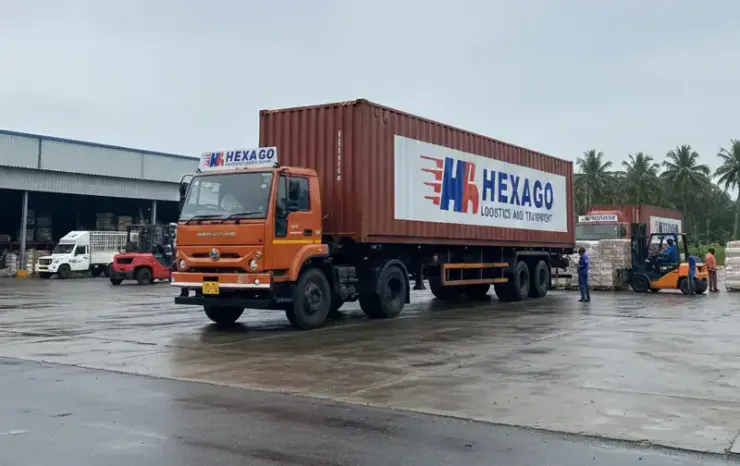
In FTL logistics, your cargo occupies the entire truck. The vehicle travels directly from pickup to delivery without stopping to load or unload other shippers' goods.
- Typical load: above 5 tonnes
- Vehicle moves point-to-point — no intermediate hub stops
- Faster transit times compared to PTL
- Fewer cargo handling touchpoints = lower damage risk
- You pay for the full truck capacity regardless of fill
What Is PTL (Partial Truck Load)?
In PTL (also called LTL — Less than Truck Load), your cargo shares the truck with other shippers. The vehicle makes multiple stops to consolidate or distribute freight at logistics hubs.
- Typical load: 100 kg to 5 tonnes
- Cost shared across multiple shippers — lower per-kg rate
- Transit time is longer due to hub consolidation stops
- Ideal for regular smaller consignments on fixed lanes
- You pay only for the space your cargo uses
FTL vs PTL: Side-by-Side Comparison
| Factor | FTL | PTL |
|---|---|---|
| Minimum load | 5+ tonnes (recommended) | 100 kg |
| Cost structure | Full truck rate (higher absolute cost) | Per-kg / per-unit rate (lower cost for small loads) |
| Transit speed | Faster — direct route | Slower — hub stops |
| Handling | Minimal — stays in one truck | Multiple load/unload at hubs |
| Damage risk | Lower | Slightly higher |
| Best for | High-volume, time-sensitive, fragile goods | Regular smaller shipments, budget-conscious moves |
| Flexibility | Fixed capacity booking | Book only what you need |
When Should You Choose FTL?
Choose FTL when one or more of the following is true:
- Your shipment exceeds 5 tonnes. At that weight, sharing rarely saves money — the PTL per-kg rate often exceeds FTL total cost.
- Speed is critical. FTL moves door-to-door without hub delays. If your deadline is tight, FTL reduces transit by 1–2 days on most lanes.
- Your goods are fragile or high-value. Pharmaceutical products, electronics, glassware, and precision equipment benefit from minimal handling. FTL keeps your cargo in one vehicle start to finish.
- You need time-specific delivery. FTL can be scheduled with a committed delivery window. PTL schedules are more fluid.
- Your cargo fills 70%+ of a truck. If you are paying for most of the truck in PTL anyway, FTL gives you speed and control for a comparable total price.
When Should You Choose PTL?
PTL is the right choice when:
- Your shipment is between 100 kg and 5 tonnes. This is the core PTL window — cost savings are clear.
- You ship regularly on fixed lanes. FMCG distributors, e-commerce businesses, and retail suppliers shipping the same route every week benefit greatly from PTL's reliability at scale.
- Cash flow matters more than speed. PTL frees up working capital that would otherwise be tied up in booking full trucks for small loads.
- You are sending non-fragile goods. Packaged dry goods, textiles, books, and similar products handle hub consolidation well.
- Your delivery window is flexible — 24 to 48 hours longer than FTL transit.
Real Scenarios: Which Would You Choose?
Scenario 1 — Garment manufacturer in Tirupur shipping to Delhi
Weight: 8 tonnes. Deadline: 4 days. Goods: packaged clothing (non-fragile).
Answer: FTL. At 8 tonnes, PTL per-kg rates would approach FTL cost and take longer. Booking a dedicated truck gets this to Delhi in 3 days.
Scenario 2 — FMCG distributor in Kochi shipping to Coimbatore
Weight: 800 kg. Frequency: twice a week. Goods: packaged food (non-fragile).
Answer: PTL. A regular small consignment on a short lane is exactly what PTL is designed for. Shared cost, reliable schedule.
Scenario 3 — Electronics company in Bengaluru shipping display units to Mumbai
Weight: 2 tonnes. Goods: high-value, fragile. Customer deadline: strict 48-hour window.
Answer: FTL. Even at 2 tonnes, the value and fragility of the goods make FTL's lower handling risk worth the premium. Speed also meets the deadline.
FTL and PTL Services in Kerala
If your business is based in Kerala — or if you are shipping to or from Kerala — Hexa-go Logistics and Transport provides both FTL and PTL services from our Aluva, Ernakulam base. We cover pan-India routes across 1,000+ pincodes in 7+ states.
Our team will help you assess your shipment requirements and recommend the right mode — no pressure, no upselling.
Quick Decision Guide
- Load > 5 tonnes → FTL
- Load < 5 tonnes and time is flexible → PTL
- Fragile or high-value goods → FTL
- Regular weekly smaller shipments → PTL
- Tight delivery deadline → FTL
- Budget-first, non-urgent → PTL
Not Sure Which One You Need?
Share your shipment details with our team. We will recommend the right mode and give you a transparent quote within 24 hours.